Oral history
Pen fight rules across India
The flick was familiar. Everything around it belonged to the classroom.
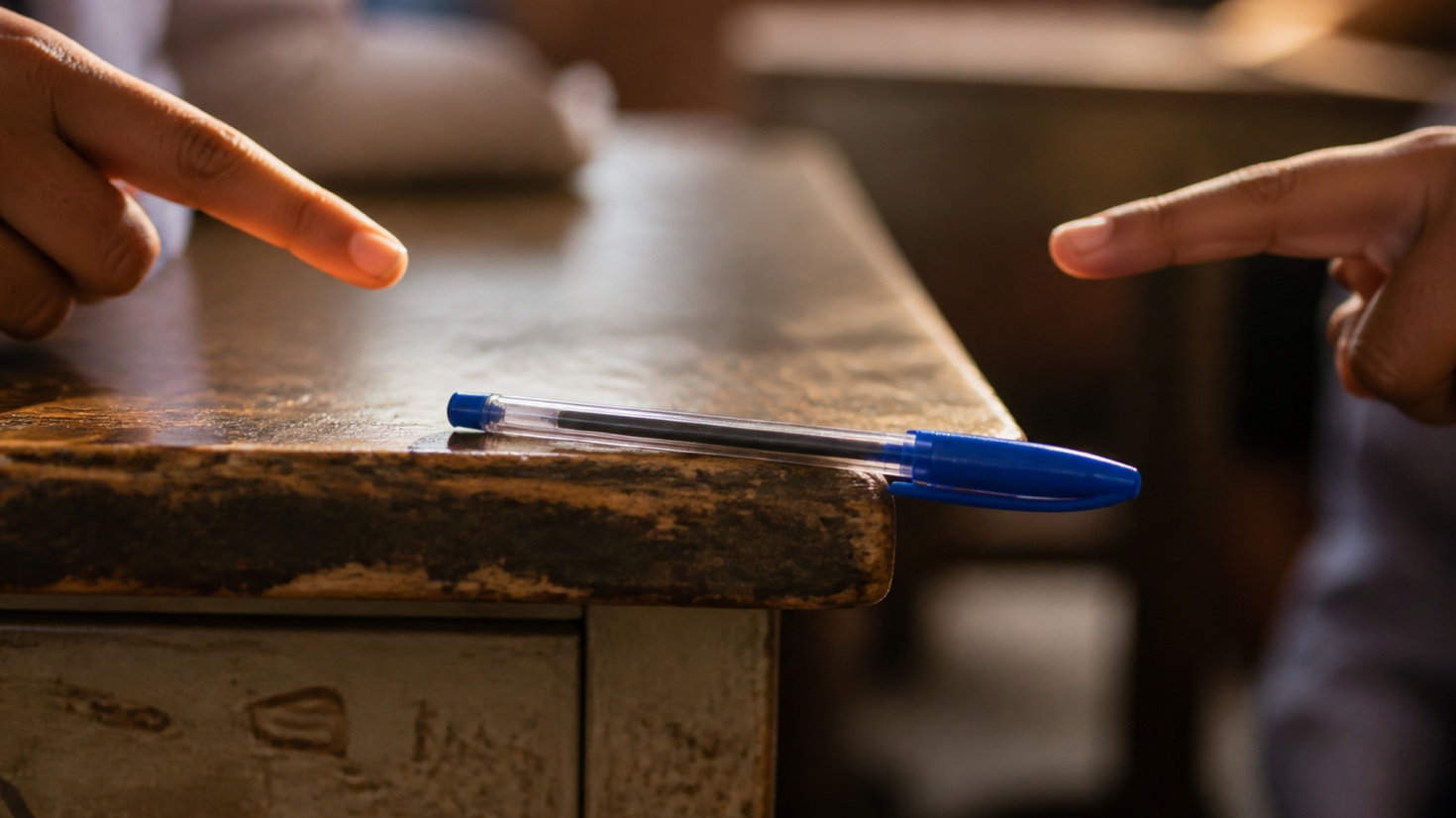
Across India, the common pen fight rule was simple: flick your own pen and knock the other pen off the desk. Classrooms disagreed about the rest. Some required the pen to fall, some counted an overhang, some punished a missed shot, and some allowed rubber grips or played for ownership of the pen.
Pen fight moved by demonstration. A classmate or older sibling showed the motion, then the next group adjusted it to the desk in front of them. That is why people from different cities recognise the game immediately and can still disagree on the first edge call.
The Digital Folklore Archives at the University of Southern California records a student from Mumbai describing the same core game: two pens on a desk, each player flicking their own, with the aim of sending the other one off. A 2008 UC Berkeley report gives a similarly short description. Neither source presents a national rulebook because there was not one.
The rule most people shared
You touched only your own pen. One flick moved it across the table. If the other pen went off and yours stayed, you won. Lifting or throwing the pen did not count as a normal shot.
That small core travelled well because it needed no marked court and almost no explanation. The edge of the desk supplied the boundary. Every variation below could change without making the game unrecognisable.
Did the pen have to fall?
This is the most common disagreement. On a flat table, a pen that crosses the edge usually falls. School desks often have a raised strip, a groove, a metal frame or years of damage near the lip. A pen can hang there without returning to the game.
Three versions appear in people's recollections:
- Fall: the pen is safe until it reaches the floor.
- Overhang: any part beyond the edge is out.
- Centre: the pen is out when more than half its body has crossed.
The fall rule was easy to judge. The centre rule dealt better with desks that physically stopped the pen. Both were workable as long as the call did not change halfway through a match.
What happened after a miss?
Many groups treated a miss as an ordinary wasted turn. You flicked, touched nothing, and the other person played. Some used a stricter contact rule. After the first move, failing to hit another pen meant losing the round or giving the opponent an advantage.
The contact rule solved a local problem: a player could keep moving away instead of fighting. It also made beginners lose quickly. A class that wanted short, aggressive rounds might like it. A lunch-break match between two new players probably did not need it.
Double-outs had no settled answer
A hard collision can send both pens off. One class replayed the round. Another blamed the shooter for losing control. A third watched which pen fell first or last. Memory is not consistent because the rule was not consistent.
A replay is the easiest modern choice. It avoids an argument about two pens falling almost together. The shooter-loses version is useful if the group wants to discourage reckless power.
Modified pens divided classrooms
Extra rubber around a grip was common enough to be remembered across many discussions. It could add traction or change where the pen was struck. Putting the cap at the other end changed balance. Shortening a refill changed weight.
Other modifications went much further. People describe sand, putty, metal pieces and nails inside barrels. Those builds were banned in many groups and should stay banned now. A hidden sharp object is not a clever rule variation. It is a safety problem.
There were three broad customs:
| Pen rule | What it meant |
|---|---|
| Stock only | The pen stayed as sold, with its normal cap and refill. |
| Visible changes | Extra grip or cap changes were allowed if the opponent could see them. |
| Open class | Players built specialised pens, often leading to new bans after one became too strong. |
Was the losing pen taken?
Sometimes. Plenty of matches were only for the score. Other groups agreed that the winner kept the pen used in the round or match. That possibility changed which pen someone was willing to put down. A common ballpoint and a prized gel pen did not carry the same risk.
Taking the pen was a local agreement, not the definition of pen fight. If nobody clearly agrees to stakes before the first shot, both pens go back to their owners.
Best of three or first to three?
Best of three means the first player to win two rounds takes the match. First to three can last five rounds. People often use the phrases loosely, which creates another avoidable argument.
Some classes played a single knockout because that was all the time available. Others kept a larger score or ran informal tournaments. The length followed the break, the teacher and how many people were waiting.
Two players were common, not compulsory
The cleanest version has two pens. Larger groups placed three or more on the same desk and played last pen standing. Turn order mattered once someone was knocked out. Some groups gave points for each knockout, while others cared only about the final pen left.
A fixed clockwise order is the easiest version. Remove a knocked-out pen and continue from the next player.
Help build a better record
Most available accounts describe one school, one city or one group of friends. That is useful oral history, but it is not enough to claim that one rule belonged to a whole state. A proper map needs many small accounts and their dates.
If you remember your version, send the city, approximate school years, edge rule, missed-shot rule, favourite pen, whether modifications were allowed, and whether the winner kept anything. Write to hello@penfight.xyz. Accounts will be grouped by place and period without publishing schoolmates' names.
The documented starting points are USC's Mumbai oral-history record, the UC Berkeley description, and public Indian nostalgia discussions. Individual comments show variation; they do not prove a state-wide rule.
The browser version fixes one rule set so both sides get the same call.
Play Pen Fight