Strategy
Pen fight tricks that help you win
Seven useful shots, starting with the one most people ignored: getting away from the edge.
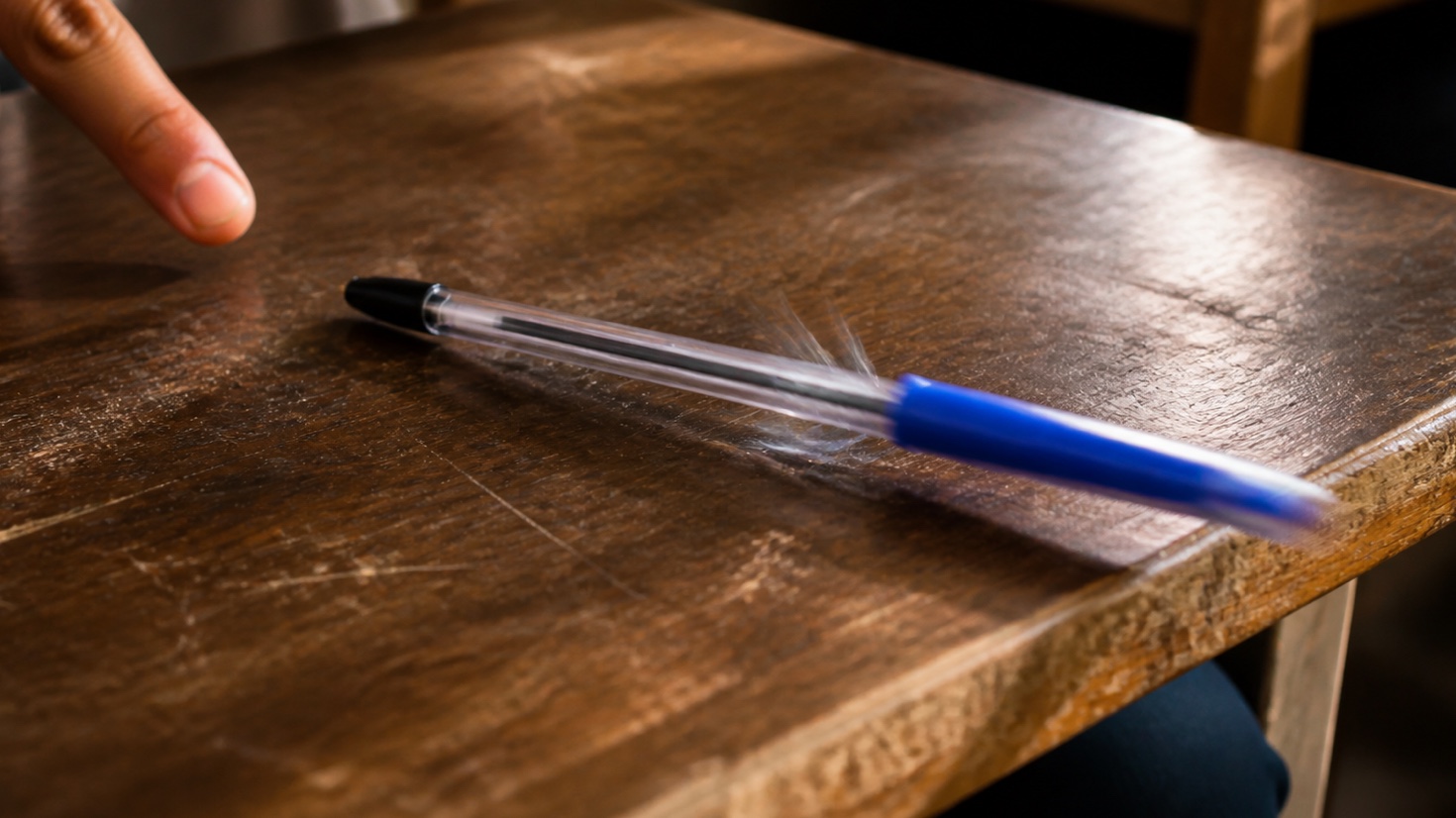
The best pen fight trick is to leave yourself a safe next shot. Stay away from the edge, use less power than your first instinct, and hit the other pen slightly away from its middle when you want it to turn. A clean knockout is good. A hard hit that sends both pens to the floor is not.
Pen fight looks like a test of who can flick hardest. That works when the other pen is already near the edge. Everywhere else, power creates a second problem: your own pen keeps travelling after contact. The useful shots are the ones that move theirs towards danger while leaving yours somewhere playable.
1. Move to the middle before attacking
If your pen is close to an edge, a big attack asks one shot to do two jobs. It has to hit the other pen and somehow keep yours on the desk. Use a small flick towards open wood instead. Giving up an attack feels timid, but it removes the easiest way to lose.
The middle is not automatically safe. It simply gives you more directions to miss in. From there, an overhit has room to slow down and the other player has fewer obvious corners to aim at.
2. Hit the middle for a straight shove
A hit near the middle of a pen sends more of the force through its body. The pen may still turn, especially if it is round or already moving, but the result is usually straighter than an end hit. Use this when the opponent is lined up with the nearest edge and you want distance more than spin.
Do not aim at the centre of the desk. Aim through the other pen towards the piece of edge you want it to cross. That small change turns a vague hard flick into a shot with a destination.
3. Clip an end when the straight path is bad
Hit near one end and the pen turns around its middle. This is useful when a straight push would leave the opponent safe, or when you can expose one end and send it towards a side edge. It also costs control. A thin pen can spin far enough to point somewhere you did not plan.
Start with a gentle end hit. If the pen barely turns, add power on the next attempt. Learning the angle first is cheaper than learning it while both pens are flying.
4. Use a glancing hit near the edge
When the other pen is already close to the lip, you often need sideways movement rather than a full collision. Aim so the side of your pen brushes it. Your pen keeps part of its forward path while theirs is nudged outwards. The shot is harder to aim, but it reduces the chance of following the opponent over.
This is where a lighter flick can beat a dramatic one. The desk edge is already doing most of the work.
5. Make the opponent cross your line
Two pens that sit parallel can be awkward. The target is long but narrow from your direction. A small positioning shot can turn your pen so the next line crosses theirs. You are creating a wider contact, much like putting a road across another road instead of trying to meet it from behind.
This also helps against someone who keeps escaping along the same side. Change the line first. Chase second.
6. Learn three powers, not twenty
Most people do not need a perfect power scale. They need three repeatable flicks:
- A nudge that moves your pen without risking the edge.
- A normal shot that can cross the middle of the desk.
- A knockout shot kept for a pen that is already in trouble.
Practise those three with the same finger and the same part of the barrel. Consistency makes aim easier because you stop changing everything at once.
7. Read the pen you brought
Round, smooth pens keep moving and can roll after a hit. Rubber grips slow a pen but can also make it stop short. A heavy pen is harder to shift, yet it can carry its own momentum over the edge. A triangular barrel such as a Trimax behaves differently again because it settles on a flat side.
There is no shot that works the same with every pen and every desk. Take two or three practice flicks before playing for a score. If you are still choosing one, the guide to the best pen for pen fight explains the trade-offs without pretending one model wins everywhere.
The tricks that usually lose
Maximum power on every turn is the obvious one. Reaching across to get a better angle is another; many groups called that lifting or moving the pen by hand. Filling a barrel with metal, sand or putty also changes the contest and can turn a harmless desk game into a damaged pen or an injury. Play with stock pens and decide the local rules before the first shot.
People remember all sorts of school hacks, including extra rubber and weighted barrels. Current discussions still disagree about what counted as legal. That disagreement is part of the game, but it is not a reason to put sharp or loose material inside a pen.
A five-minute practice
- Put one pen in the middle and land three nudges without reaching an edge.
- Place the target across the desk and make three centre hits.
- Hit the left end, then the right end, using the same power.
- Move the target near an edge and try three gentle glancing hits.
- Finish with one full round where position matters more than speed.
If a move keeps failing, change either the contact point or the power, not both. You will know which change fixed it.
This guide uses ordinary rigid-body behaviour and the school rules collected in USC's Digital Folklore Archives. Local rules varied, so settle missed shots, overhangs and modified pens before playing.
You can practise centre hits, end hits and careful edge shots on the browser desk.
Play Pen Fight