Guide
What is pen fight?
A school desk game from India. Two pens, a flick, and whoever's pen stays on the desk.
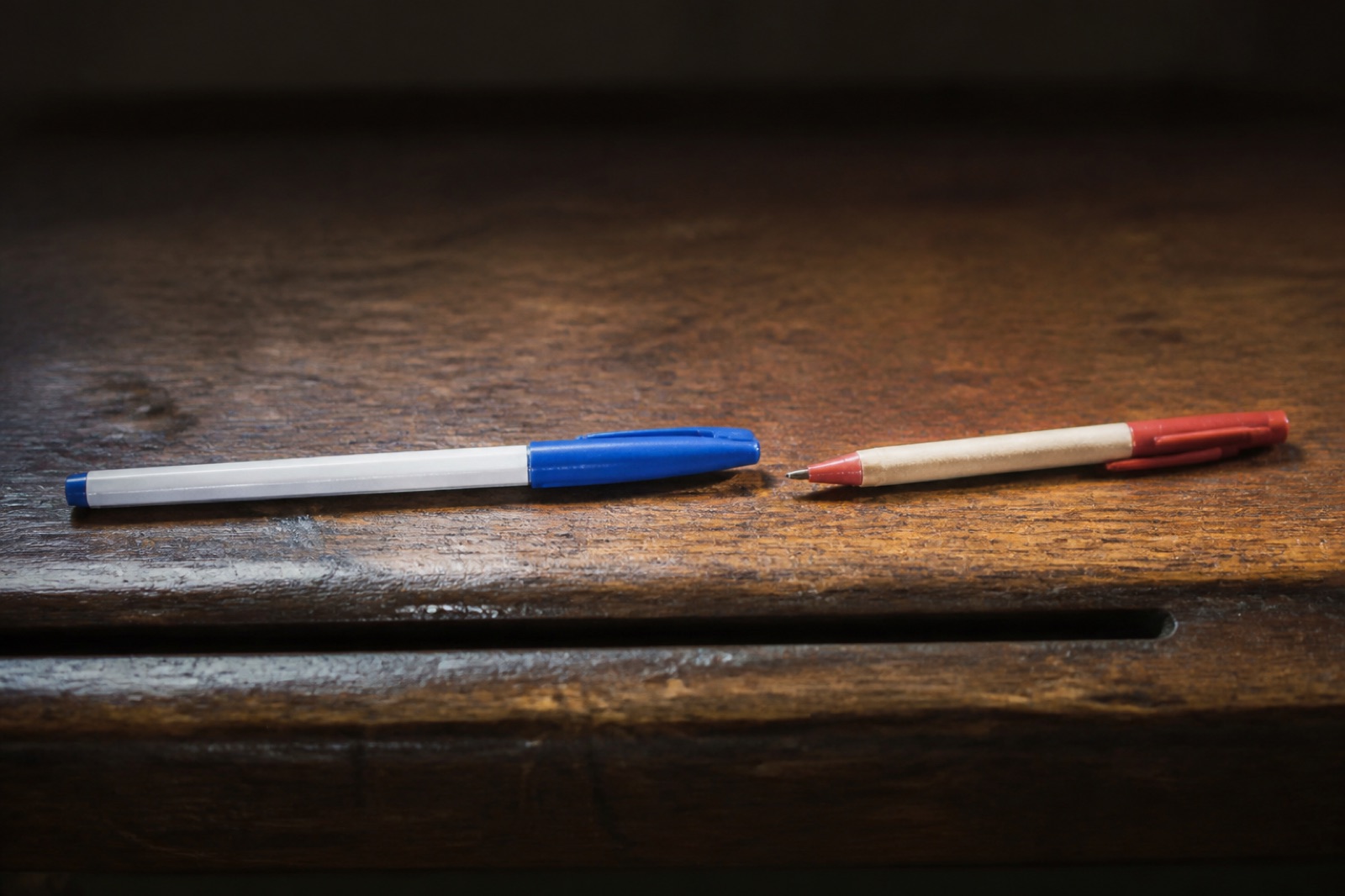
Pen fight is a game kids played on school desks across India. You do not need a board, dice, a special table, or anything you would have to buy for the game itself. You need two people, two pens, and the desk you are already sitting at. That is the whole setup.
Each person puts one pen down on the wood. You take turns. On your turn you flick only your own pen, so it slides across the desk and hits theirs. If theirs goes over the edge and falls, you have won that round. If yours goes over, they have. The pen that is still on the desk is the one that counts.
If that sounds small, it was. It had to be. This happened in a classroom, often while a lesson was going on at the board. A good shot is almost silent. A pen hitting the floor is not, and that is usually when the teacher turned around.
It sat next to the other small games of that time. Book cricket in the back of a notebook. Raja mantri on a folded chit. Red hands in the corridor. Same idle minutes, same school, nothing you had to pack. There was never an official rulebook. The kid next to you showed you once, and then you knew.
Who played it, and when
Most of the people who still talk about it went to school in the 1990s and 2000s. Cheap ballpoints were already in every pouch by then. Desks were still shared: one long plank, two students, one writing surface. You did not have to clear a space or stand up. The pens were already there because you were supposed to be writing with them.
It was not a sport with a season. It was what happened in the last ten minutes of a period, or on a break, or at lunch when two people sat down at the same bench. Some rooms played every day. Some rooms played when a particular pair of kids sat together. It died off when those kids moved, and it started again when someone new sat last bench and already knew.
You will hear it from CBSE schools and state-board schools, English-medium and not, different cities, the same flick. That is how you know it was not invented in one place and exported. It is the kind of thing children pass to each other because the materials are already in the bag.
What a flick actually is
You do not throw the pen. You do not pick it up and toss it at the other one. You keep it on the desk the whole time. One finger on the barrel, pull it back a short way, let go. The wood carries it. If you lift it off the surface, most groups called that cheating. If you hit twice in one turn, that was cheating too.
Power without aim sends your own pen over the edge, which means you lose the round you were trying to win. Aim without power leaves both pens sitting there, closer together, which makes the next shot harder. People learned that the same way they learned anything at a desk: by doing it badly a few times.
A full match, from sitting down to first-to-three, is in how we used to play.
What you might win
Some groups played only for the point. First to three rounds, then you stop, pens go back in the pouch, nobody has lost anything except the argument. Some groups played with the pen itself on the line. If you lost, they kept the one you had just been flicking. Both happened. There was no cash. There was no scoreboard that outlived the period.
A Reynolds 045 was the ordinary school ballpoint. Light, everywhere, the one you could put down without thinking much. A Parker, a Trimax, or an Add Achiever was heavier and cost more. People thought twice before putting those down, which is why those names still come up when anyone talks about the game.
Where it happened
The picture most people have is the last bench: the back row of an Indian classroom, two kids on a dual desk, the blackboard a long way off. That is not the only place it happened. Breaks and lunch were easier, because you did not have to hide it. A notebook could stand in for the desk if that was the surface in front of you. The constant is a flat thing with an edge. Off the edge is out.
Teachers catching you was part of it. Parents saying pens were for studying was part of it. Neither of those things was a mystery. The game still happened, because the desk was there and the period was long. How the habit spread, with no inventor, is in how kids learned it.
Common questions
What is pen fight?
A flicking game on a school desk. You slide your pen into the other person's pen. If theirs goes off the desk, the round is yours.
Where was it played?
Classrooms across India, often the last bench. Also on breaks and at lunch.
Did the winner keep the pen?
Sometimes. Some groups staked the pen they played with. Some just played for the match.
Is it only from India?
The version people mean when they say pen fight is this school desk game, from India and nearby. The same idea (knock an object off a surface) exists elsewhere. This is the one with a 045, a last bench, and a teacher at the board.
Is it the same as pen spinning?
No. Pen spinning is tricks in the fingers. Pen fight is two pens on a desk, sliding into each other. Different hobby, same stationery.
If you want to flick a pen on a desk again, there is a version in the browser.
Play Pen Fight